

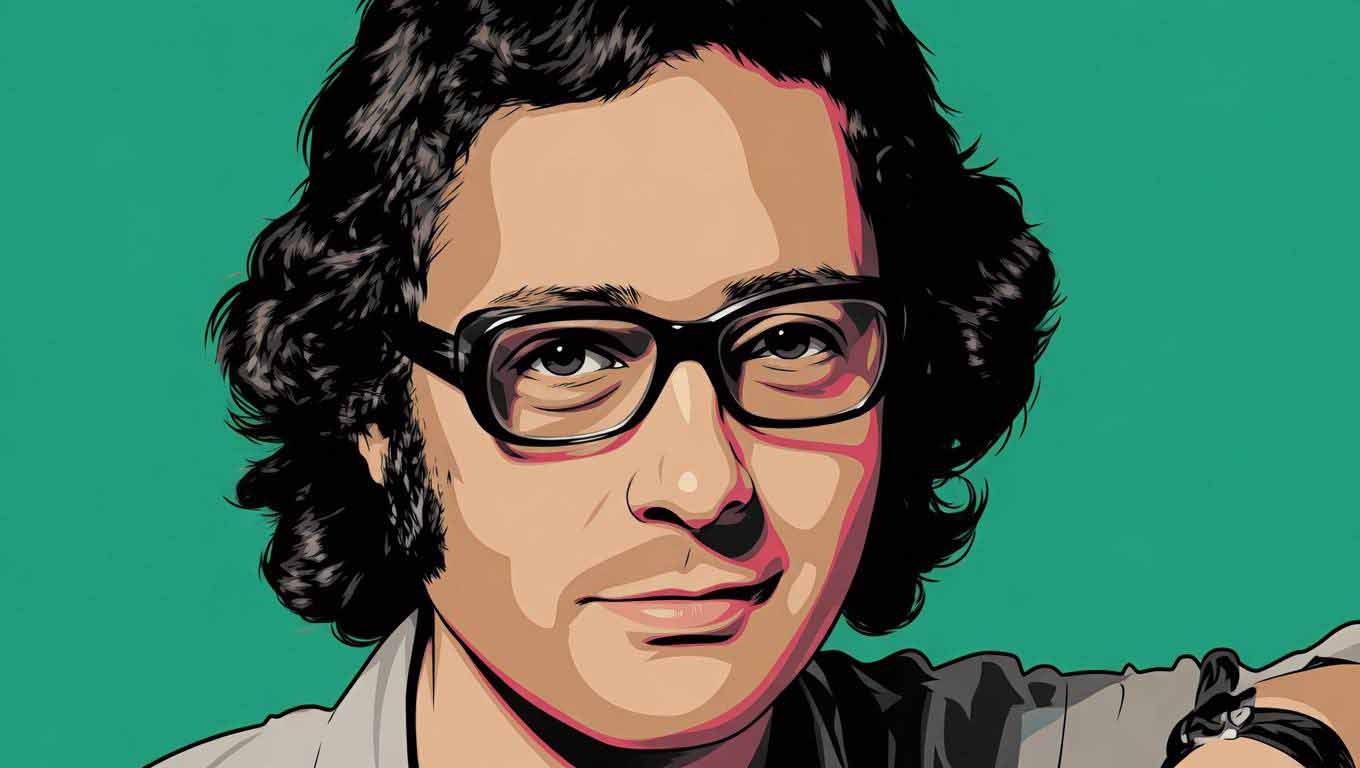
May 20th (30 Ordibehesht) marks the birth anniversary of Ahmadreza Ahmadi, a poet, writer, playwright, painter, and actor whose career cannot be confined to any single mould. He passed away in Tehran on July 11, 2023 (20 Tir 1402), at the age of 83, after months of struggling with heart disease, yet he remains one of the most controversial and influential figures in contemporary Iranian poetry. A review of the various dimensions of this multifaceted artist's life and work reveals a unique portrait that fits no pre-established pattern.
A Dual Existence and the Formation of an Artist
Ahmadreza Ahmadi, the youngest child of his family, was born in Kerman in 1940 (1319 SH). From his early school years, he tasted migration. His family moved to Tehran in 1947 (1326 SH), and the young Ahmadi attended high school at the capital's Dar ol-Fonun. These two different environments – the simple, warm desert of Kerman and the eventful, shrewd metropolis of Tehran – created a rare fusion within him that lasted his entire life. He had the simplicity and warmth of a Kermani, alongside the sharpness and savvy of Tehranis. He described his teenage years in Tehran as "very terrible," filled with "coldness, loneliness, and estrangement" – days when he witnessed people being arrested and taken away during protests. Nevertheless, in those same turbulent days, he remembered the sound of Master Ebrahim Selmaki's santour coming from a class next to his school – this contradiction, that art always found refuge for him in the heart of crisis, ran through his entire life.
A Face Worthy of Cinema
Ahmadreza Ahmadi was not merely a poet of books. He knew himself well and knew that he was photogenic. His presence in cinema, especially his role in Dariush Mehrjui's film The Postman (Postchi), is so memorable that it seems the cinematic frame was made for him. Among poets who also stepped into cinema, his name appears alongside Manouchehr Atashi, Mohammad-Ali Sepanlou, Shams Langeroudi, and Rasoul Younan, but Ahmadi, in terms of looks and acting ability, transcended conventional boundaries. He was a handsome actor in that film, one whose presence in Iranian cinema could have been serious and lasting.
Correspondence with Forough Farrokhzad: Discovering the "Exceptional Self"
One of the key moments in the formation of Ahmadi's artistic personality was his relationship with Forough Farrokhzad. Ahmadi showed his first poetry collection Tarh (Design/Sketch) to Farrokhzad, and she received it with great enthusiasm. But more importantly, there were letters exchanged between the two poets. In a letter to Ahmadi, Farrokhzad criticised the "fake intellectual life of Tehran" and urged him to follow his own path. According to sources, Ahmadi received his "literary passport" from Forough Farrokhzad. He learned from her that to be a poet, one must prioritise "being oneself and being exceptional." It was this correspondence that sparked the early glimmers of the "New Wave" in his mind.
"New Wave": A Solitary Rebellion That Became Cultural
It was the 1960s (1340s SH), and Persian poetry was caught in the battle between tradition and modernity. Ahmadi, weary of the "boring romantic perfume" and repetitive political slogans, published his first collection, Tarh, in 1962 (1341 SH). The book caused such an uproar that it excited many young people tired of the existing atmosphere, while provoking the anger of traditionalists. Thus the "New Wave" (Mowj-e No) was born in Persian poetry. Although Ahmadi started this movement alone, it quickly turned into a modernist current in Iranian culture. The characteristic of his New Wave poetry was neither like Nimaic poetry, nor like Forough's, nor like any other official tradition. His poetry was like a "collage of seemingly random images" – simple yet full of ambiguity and mystery. In 1964 (1343 SH), together with contemporary artists such as Nader Ebrahimi, Mohammad-Ali Sepanlou, and Bahram Beyzai, he founded the "Tarfah" group to defend this new art, and published two issues of its magazine.
The Institute for the Intellectual Development of Children and Young Adults: A Second Home for a Versatile Artist
If the New Wave poetry was a sign of Ahmadi's youthful boldness, his long-term collaboration with the Institute for the Intellectual Development of Children and Young Adults (Kanun) reflected his profound view of art and society. Ahmadi joined Kanun in October 1970 (Mehr 1349) and stayed there for nearly thirty years. He initially served as music production manager, compiling and recording enduring collections such as the Radif of Iranian Music and The Avaz of Mohammad-Reza Shajarian. Later, he continued working in Kanun's publications department as an editor. One brilliant example of this collaboration is the famous album Aftab Amad, Aftab-e Mehr Amad (The Sun Came, The Sun of Kindness Came, 1975/1354 SH) – a fusion of Rumi's poetry with Ahmadreza Ahmadi's poetic language, composed by Dariush Dolatshahi and narrated by Bijan Mofid. This work demonstrated how transparent and unadorned Ahmadi's poetry could be, and how it could evoke a shared feeling of "nostalgia, kindness, and simplicity" in both adolescents and adults. At Kanun, he became a cornerstone of art for children, and this extensive role placed his name on the nominees' list for the prestigious Hans Christian Andersen Award (the "Nobel Prize for Children's Literature") in 2010.
Bitter Humour: The Final Signature of an Artist
Alongside all this artistic and managerial seriousness, what distinguishes Ahmadreza Ahmadi from the multitude of poets is his unique humour – a bitter, biting yet gentle humour rooted in his behaviour and speech. A famous quote preserved by Mohammad Saleh Ala is the best evidence of this trait: "Let's make an appointment, sit down, and sigh." In this single sentence, all the bitterness and sweetness of his outlook on life flows. When in his final days he was repeatedly hospitalised, and his daughter Mahour wrote of his "restless and agitated" state, it was again this bitter humour that could change one's perspective on life: "Wherever it may be, his star will shine forever in the sky."
Untimely and Timely Honours
During his lifetime, Ahmadreza Ahmadi received numerous awards, from the Bijan Jalali National Award for his collected poems (2006/1385 SH) to the "Flying Pencil" statuette from Kanun. Nevertheless, he complained about the delay of a culture of appreciation in Iran. A year before his death, he said frankly in an interview: "Paying attention to artists should happen in their own time. Not building statues for them after they die." A sentence that again carried his bitter humour within it: "If you want to build my statue, give me the money, and I'll stand in its place myself."
The End of the Story
Ahmadreza Ahmadi passed away on July 11, 2023 (20 Tir 1402), after a long illness. His works have been translated into various languages including English, French, German, Japanese, and Korean, and he left behind more than fifty books in the fields of poetry, fiction, and drama. But perhaps his greatest legacy is demonstrating the truth that a poet can be both simple and exceptional; that while being an actor and photogenic, he can pack the deepest philosophical concepts into the simplest words; and that while possessing a bitter humour, he can bring solace to the weary souls of his audience. He was an "artist" (in the fullest sense), and in the entire stature of being an artist, he walked his own path.
🗣 نظرات (0)