

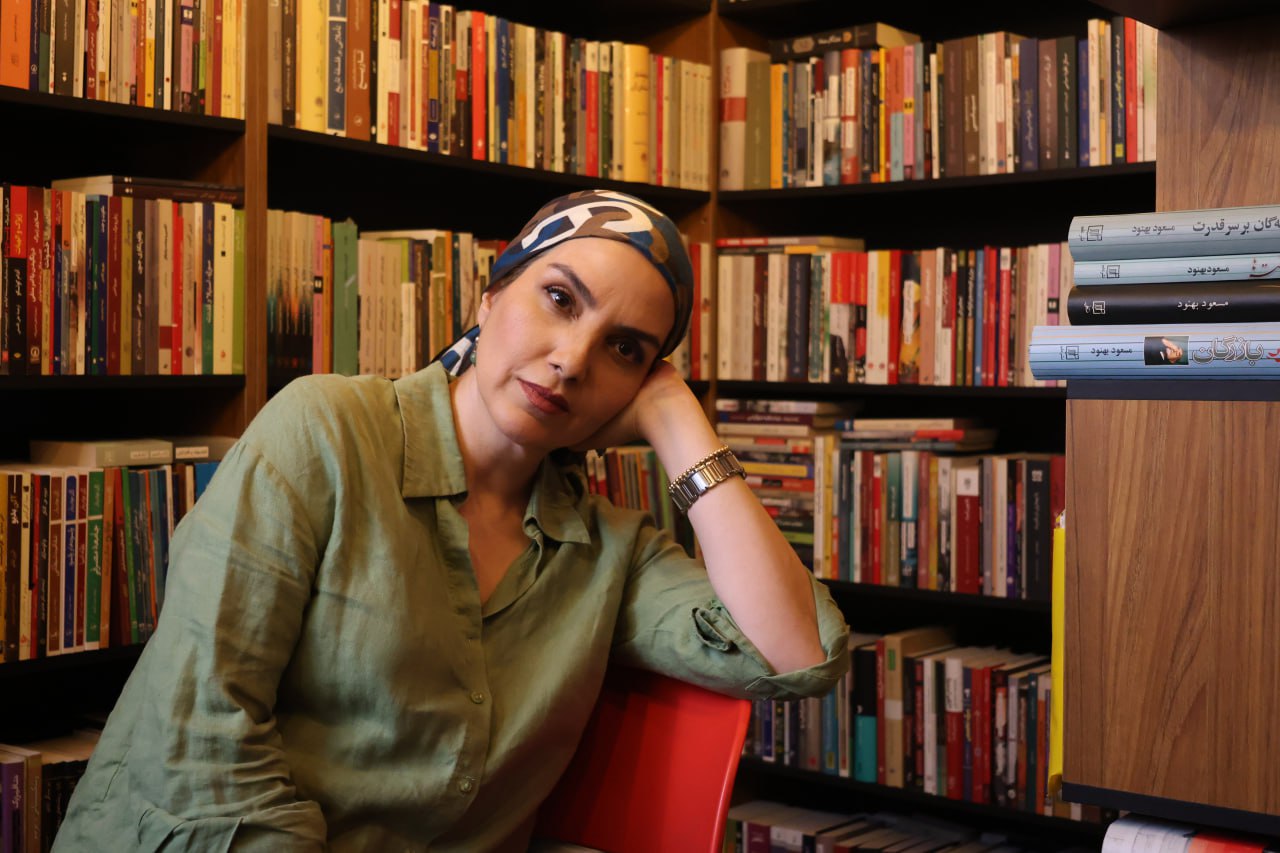
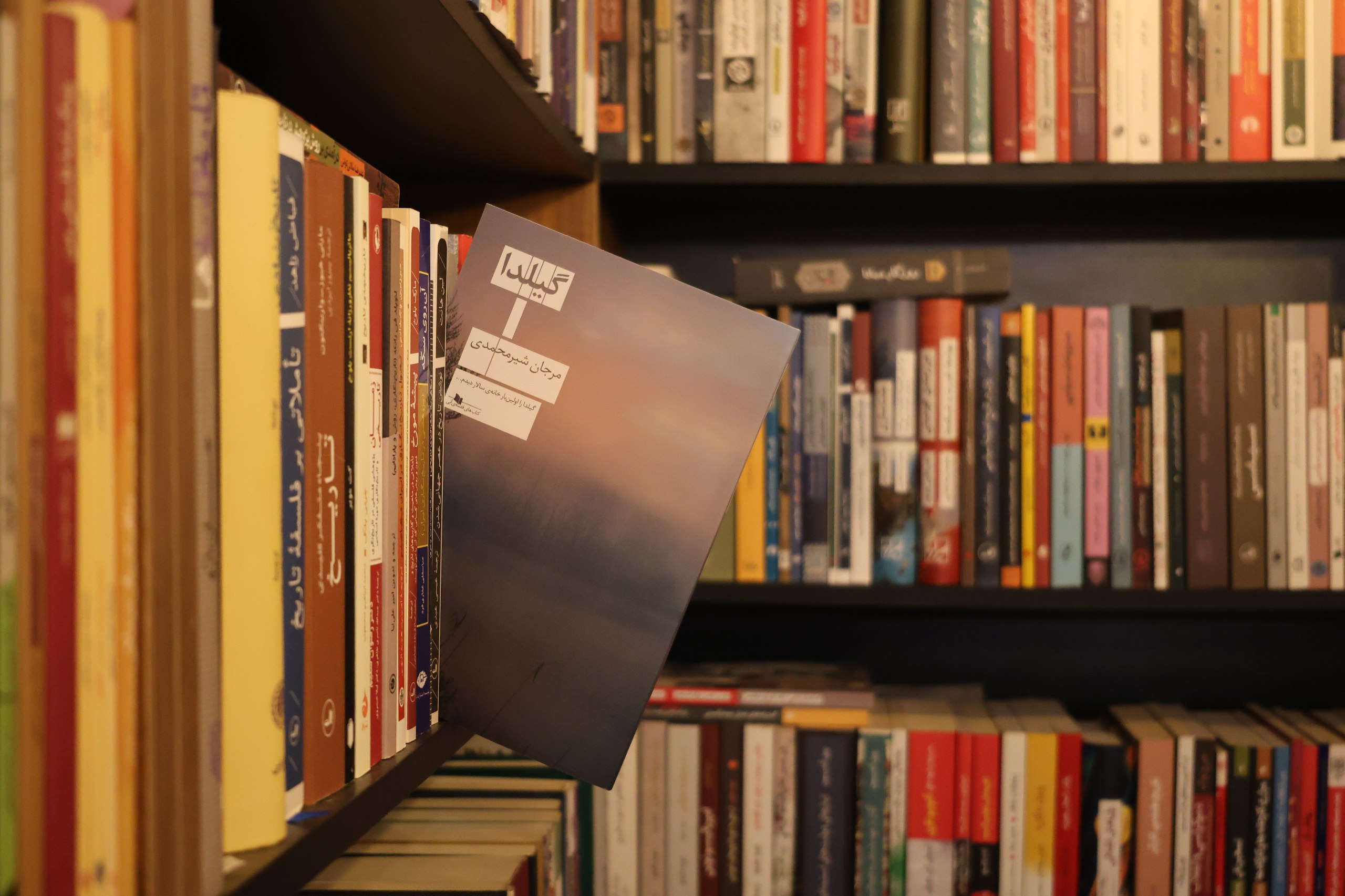
Roozbook: Many people know Marjan Shirmohammadi through her acting career and presence in Iranian cinema, but over the past two decades she has also become one of the serious voices of contemporary Iranian fiction. From her short-story collections to novels such as The House of the Poles, she has consistently explored marginalized individuals, complex human relationships, and female characters. Her latest novel, Gilda, tells the story of a determined and demanding woman who embarks on a turbulent journey to reclaim what is rightfully hers. According to the author, the novel grew out of her fascination with bold and combative personalities.
In the following interview, Marjan Shirmohammadi talks about the creation of Gilda, the experience of writing it during the most difficult period of her life, its differences from her previous works, the process of obtaining publication permission, and the relationship between reality and imagination in fiction writing.
Does the protagonist of Gilda have a real-life counterpart?
The stories a writer creates are partly born from imagination and partly from lived experience—from people they have encountered, the environment they have lived in, and the relationships they have observed. Gilda herself did not have a specific real-life counterpart for me. Throughout my life, I have always been fascinated by people who are courageous and possess a strong desire to live—people who continue to stand firm despite pain and suffering. I had seen such individuals around me, but Gilda was not directly based on any one real person. There are other characters in the novel whose real-life counterparts I have more or less encountered, but that was not the case with Gilda.
In Gilda, there are subtle references and allusions to certain well-known people. Since you have been active both in cinema and literature, were these references motivated by admiration or did they contain a critical perspective?
No, I would not say they were critical in nature. When Truman Capote wrote fiction, he often ended up making enemies because some people believed his characters were based on them. They would tell each other about it, and eventually some of them would stop speaking to him. If we look at it from that angle, then yes, some characters in my stories may resemble real people in one way or another, perhaps under different names. But I cannot say there was any particular critical intention behind them. They simply found their way into my stories.
Gilda differs from some of your other works, especially The House of the Poles, particularly in its dialogue-driven structure. The stylistic shift is very noticeable. Where did this change come from? Was it dictated by the story itself?
Every story has its own requirements and naturally brings its own style with it. Compared with The House of the Poles, Gilda is a much more contemporary story. People today are different from people fifty years ago, and that difference is naturally reflected in language and narrative style. In my view, the story itself determines its style.
If we go back to the beginning, how was Gilda born?
I have always been drawn to people who are courageous and possess a powerful desire for life—people who stand firm despite pain and suffering and who are even willing to fight life itself. Rebellious characters have always interested me. Gilda is such a character: a woman who, despite having lived a difficult life, stands her ground and fights to reclaim her rights. I found those qualities extremely compelling.
Especially for women, the opportunity to fight is often limited. For various reasons—culture, motherhood, and many social constraints that restrict them—they either do not develop the courage or do not find the opportunity to stand up against circumstances. I wanted to create a female character who, despite all her hardships, strives to claim her rights, remains demanding, and continues to fight.
Female characters have always been present in your work, but Gilda is different from your previous female protagonists. You have also mentioned that you wrote this novel during a very difficult period of your life. Could you tell us more about that?
Yes, I truly wrote Gilda during the hardest days of my life. However, I prefer not to talk about those difficulties. I do not see a reason to do so. But as I mentioned, what matters to me is the ability to stand firm and fight through hardship. Writing this novel was a form of fighting for me—a form of resistance against adversity.
Perhaps if Gilda had not existed, I would have broken down during those difficult days, days that divided my life into a before and an after. Perhaps Gilda was my only way of salvation.
There is also a sense of humor in Gilda, along with extensive dialogue, which distinguishes it from works such as The House of the Poles. Where did this shift in narrative approach come from?
As I said, every story has its own demands and brings its own style with it. The House of the Poles is set fifty years ago, and the people of that era are different from people today. Naturally, the narrative form and style of the story must change in accordance with its time period and characters.
You are very familiar with the world of cinema, and some of your previous works have been adapted for the screen. When you write a story, how much do you think about its cinematic potential?
Not at all. When I write, the only thing I think about is the story itself. I do not even think about how many readers it might have. I remain loyal only to the story and try to build a world.
It is like constructing a building. As I create that structure, I immerse myself in its world and enjoy the process. I am convinced that if I do not enjoy the story while writing it, and if I do not become engaged with its flow, readers will not be able to engage with it either.
So when I write, I think about nothing else—neither film adaptations nor audience size.
Nevertheless, do you think Gilda has the potential to be adapted into a film?
Yes, certainly. It definitely has that potential. However, given the existing circumstances, I do not think it would be easy. The novel includes private evening parties and similar situations. If the story could be portrayed naturally and realistically, there would be no problem. But if extensive changes had to be made because of various restrictions and regulations, the work would probably be damaged.
Who do you think the audience for Gilda is? Do you think readers who enjoyed The House of the Poles might also appreciate this novel?
I do not know. Time will answer that question. Personally, I love Gilda and have great hopes for it, but the rest is no longer in my hands.
I can only say that when a writer’s book is published, it is like an arrow released from a bow. From that moment on, the story finds its own life and follows its own path.
As I said, I wrote this novel with my whole being and during the hardest days of my life, and I hope it finds its path. From now on, it no longer needs me. I hope Gilda, like its own protagonist, is stubborn enough to find its way.
How long did it take you to write Gilda?
To be precise, I honestly do not know. I had just begun writing the novel when something happened in my life, and for several months I could not return to it. Afterward, it took me some time to regain the emotional strength and ability to write.
Because of that interruption, I cannot accurately say how long the writing process lasted.
Do you need any particular conditions or environment in order to write?
No. As Raymond Carver once said, all we need is for no one to pull the chair out from under us.
I think the most important thing for a writer is simply to sit down and begin. Once that happens, the rest is not particularly difficult.
What was the process of obtaining publication permission for Gilda like?
Gilda remained at the Ministry of Culture and Islamic Guidance for nearly two years without receiving publication approval. After considerable difficulty, numerous visits, and extensive follow-up, I was finally able to secure permission.
In the end, if all the sections removed from different parts of the novel were put together, they would probably amount to about three pages. Even that was very difficult for me. For a writer, losing even a single word can be painful.
During the many stages of revision, writers themselves remove and discard a great deal. What they finally submit to a publisher is a text from which they no longer wish to remove anything. Naturally, they do not want someone else telling them to cut this section or delete that passage.
But the reality is that we live in a place where such things happen.
What seemed strange to me was that the parts I was asked to remove were things that are happening in this very society—things all of us can see around us. The conversations I had with the relevant authorities were often difficult for me to understand.
At times I even asked them, “Do you not live in this country? Do you not see these realities?”
Their answer was: “Yes, these things exist, but they should not be promoted.”
Eventually, after many visits and much correspondence, we reached an agreement. The book was published with those deletions, and I will probably talk more about them in the future.
Nevertheless, I am happy that Gilda finally emerged from that situation and was published.
🗣 نظرات (0)